Child Labor and Education
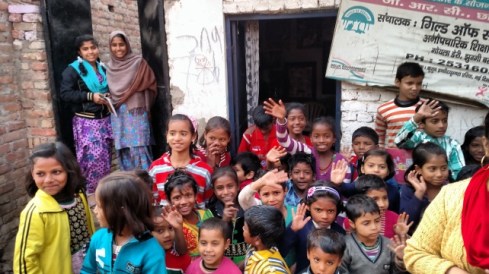
The children of India won over my heart. Whatever school we went to and whichever village we visited, they greeted us with precious smiles. I felt moved by their energy, welcome, care, vitality, and optimism. Their openness in meeting us and sharing their experiences with us was humbling.

The children loved to show off on camera, always sporting the most beautiful smiles. They especially enjoyed selfies and getting to see the photos afterwards. As we walked through various school, the teachers would lead their students through a demonstration to show off their skills. They would speak to us in English, sing and share with us what they learned in school. These comprise some of my most memorable moments.
However, children in India face terrible exploitation through child labor. Children, yell “Ma’am!” to get people’s attention, bang on vehicle doors, and try everything they can to elicit purchases from vehicle drivers or passengers for flowers, balloons, food, toys and more. Occasionally, they yell in frustration at the unresponsive drivers. Then they continue wading through stopped traffic looking for new customers, and returning to the side of the road when traffic starts moving again. When the traffic stops again, their work recommences. And it goes like that for them. All day, every day.
A high-school aged boy (and several others) followed us around Fatehpur Sikri and clearly marked me as his preferred (aka easy) customer target. He tried for about 10 minutes to get me to buy goods that I was simply not interested in. Desperate for relief from the harassment, I took out some money and begged him, “take 20 rupees for yourself and go.” But he fired back, “I am Muslim and do not take free money! Please buy something.” I was horrified that even that did not work, yet impressed by the honor of the boy (or maybe his boss was standing nearby, and he had strict orders to extract more money from the unwitting tourist). I finally yielded and surrendered to buy my unnecessary third set of postcards, which would become a gift for a colleague. Yet, even after, the boy continued to try selling more products – he was definitely the most persistent and assertive yet. Meanwhile from the corner of my eye, I caught an older man violently yank one of the children selling goods and scold him. That must have been their boss.
I felt weakened by the encounter and tragedy of the situation. In a miserable realization, the massive scale of child labor weighed down on me agonizingly. It is understandable where the behavior for harassment of potential customers comes from – out of a desperation for money, knowing that their survival and relief from the overlord rests in the hands of some fortunate tourists walking around nonchalantly.
But out of all the issues that I have witnessed and learned about in India, this one breaks me. There is an absence of schools, and an absence of children from schools. This is directly linked with forced exploitation of children through child labor. Kids as young as 5 are forcibly subject to dangerous labor – such as the girls wading through traffic to beg or sell bangles on their arms, and put in extremely vulnerable situations where they may be kidnapped, hurt, or worse. The street merchants in charge of them organize themselves similar to a mafia with its own hierarchy.
The children who work on the streets or tourist locations to sell goods, have a high level of intelligence, alacrity, and streets-smart. They speak several languages – certainly English well, and other major tourist languages like Spanish well enough. They can read who the most giving customers may be, as they are observant and trained masters of psychology. They could move mountains if provided with the opportunity to maximize their potential in contributing more positively to society. But they are desperate victims of human rights violations.
My colleague shared how faces of people reappear in her head – people in poverty, beggars, so many people in endless crowds. One face that particularly stays with me  is the small lovely child trying to sell me green toy trinkets at Amber Fort. He may have been 7 years old. He smiled up at the bus as we were boarding and raised the toys over his head to show us. We waved to him and smiled back, but said that we had to leave soon, as our bus would move in a matter of seconds. Then the child put the toys down and smiled a giant beautiful smile at us, despite our unwillingness to buy. Whereas at that point other adults or children selling goods would become frustrated and hit the sides of the bus in anger, this innocent small boy grinned and waved goodbye with such energy that it surprised me bittersweetly.
When we think of poverty, injustice, and lost potential, many instances or faces may come to mind. But at that moment, the image of the boys’s eyes in my head, I felt unstoppable tears trickling down my face as the bus rolled away.
The Akshayatra Patra foundation was founded in 2000 by Swami Prabhubada to alleviate child hunger and encourage children to go to school. Today the foundation owns mass-producing food “kitchens” or factories, and sends out trucks daily to government schools in order to provide lunch for the children there. They open new kitchens every few years, serving about 1.5 million children currently. The foundation also has a food safety and control lab.
Checking out the facilities and meeting with the organization’s heads was impressive. The organization sports the ideal private-public partnership and has the success and top awards to prove it. These are exactly the efforts of development policies and ideas discussed in the UN and at the ministerial levels- put into practice so finely on the ground. Innovative approaches such as the food for education program make a major impact and are quite popular. Already the foundation is extending and purchasing more kitchens. This is only one part of the solution to the aforementioned problem of lack of education in children, but it making a concrete difference for children and their families and communities in Uttar Pradesh and beyond.
Indeed private-public partnerships in India make an impact, as the government of limited capacity often calls upon NGOs to provide services, shelters (as in the case of the Guild for Service), conduct research on development issues, and more.

 K-squared