Originally published for Montage Initiative and the Student Advisory Board.
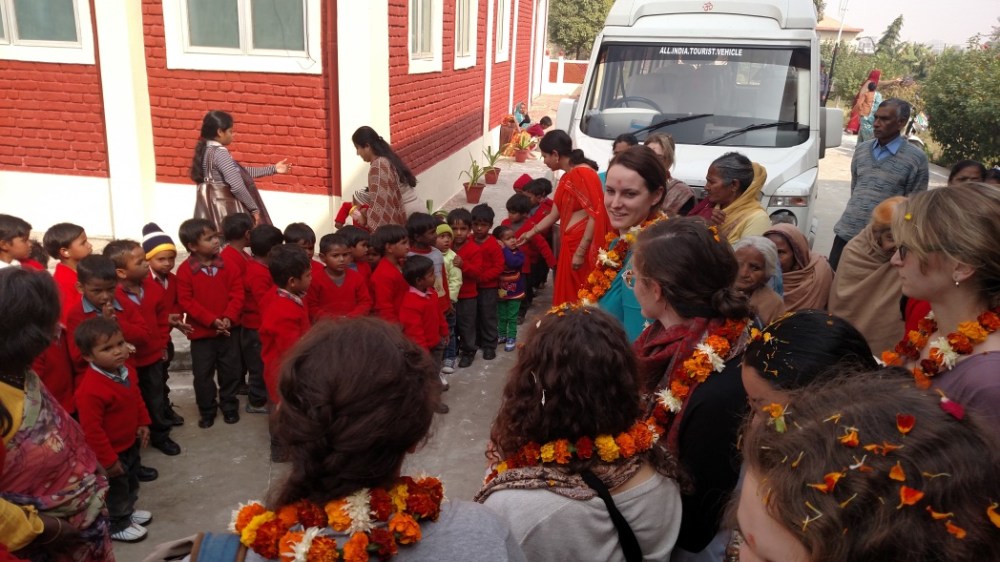
Rolling into Ma Dham shelter was one of the most emotional and memorable moments of the trip. Under the clear sky and bursting sun of midday, the sheltered widows lined up to greet us with flower necklaces in their hands. As we got off the bus, they put wreaths of marigolds around our necks and the red tikka on our forehead as is the custom when welcoming guests into Indian homes. They bowed, saying “Rather Radhe” – the main greeting in the holy city of Vrindavan, in honor of the Hindu god Krishna.
Blessed and humbled by the welcome, we met the women and listened to their stories. The widows ranged from as young as in their twenties to as old as over their 80s. Some of them had been in the shelter for a few weeks, others for decades. They came from many different backgrounds and loved to share about their families and lives. One lady in particular had been a chemistry professor and came from a family of chemists. Despite language barriers, we connected as women with a common humanity.
There is no generalizing “women” into a homogenous group in India, or anywhere else in the world for that matter. There are poor marginalized women in more rural areas, and some well-educated and empowered women in the city. But widows suffer triple marginalization: as women, poor people, and widows. When their husband dies in conflict situations (as is the case of state and militant husbands in Kashmir), a woman is left with no money or income. These are known as “war widows,” but there are all kinds of widows in India. For instance, with looming debt from purchasing seeds of GMO companies like Monsanto, several farmers are committing suicide, leaving behind “farmer widows.” The widow must then take care of her household and children, carrying on in destitution by working the fields in what is known as the “feminization of labor.”
Indeed women are at the center of poverty, as about 70% of the world’s poor are women. Women suffer poverty more frequently than men, and at more extreme levels. Furthermore, women work several full time jobs in labor, usually the informal sector, and then in domestic work, taking care of all the family’s dependents. This “feminization of poverty” is especially in the case of singleparent homes run by females, which earn the lowest incomes. This poverty is passed on between generations if girls or women are married at a young age to much older men and widowed early on, as they become stuck in the cycle of poverty. Indeed, the lack of education and poverty of women is a defining factor and the key to the overall poverty and development of India. There are about 46.5 million widows in India. 75% of women-run households are headed by widows. A widowed woman is considered bad lack in Indian culture, and she is thought to be the indirect cause of the death of her husband. Her family often shuns or even abandons her. Indian thought states that in childhood, a girl is taken care of by her father, in marriage by her husband, in old age by her son. A widowed woman is thus considered “masterless” and therefore is at the mercy of the remaining family, such as the brother in law, who often forces her into a second marriage with him in order to maintain the property that she would otherwise inherit from the death of her husband.
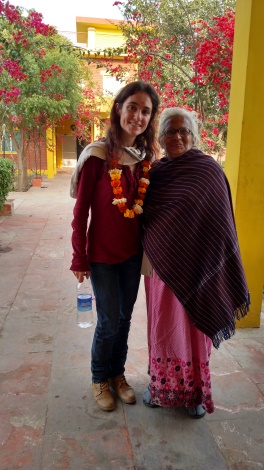
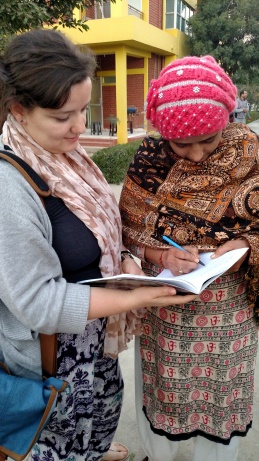
Widowed women may not wear color or jewelry or decorate themselves in any way, according to tradition. In the past, they were also made to shave their heads to remove any sign of what may be seen as beauty or decoration. In one of the most notorious practices of “sati” widowed women were pressured to kill themselves at the funeral pyre of their dead husband. This practice is now banned in India.
Abandoned by their families, many widowed women are forced to leave their home and travel to the holy city of Vridavan where they go to live out their last years in the hope of redemption and salvation. There are thousands of widows in the city of Vrindavan, Varanasi, and other areas in India. There are also many shelters, but never quite enough to house and protect them all.
Ma Dham is therefore a sanctuary for these women. There they do activities like skill building, physical exercise like yoga, visits to the city, and generally enjoy the company of one another in the beautiful compounds of the shelter. Some participate in computer courses and learn how to make crafts with their hands that they sell and earn a livelihood from. Throughout our stay in the Guild for Service’s Ma Dham shelter, we got to bond with the women through various activities, all the
while getting to know them better. One of my favorite events was a bonfire, where the widows, and our group sang and danced in the night. We even managed to get the male staff up and dancing!
Ma Dham which means “my home” really felt like a home. Even the staff was like family, especially the sweet soul Urmila. Originally from Virndavan, she works at the Guild for service, and was one of the most positive influences, always cheering everyone up, serving delicious tea, and sharing her culture with us, including teaching us how to write in Sanskrit! The staff at the Guild of Service was very kind and welcoming to us. I made friends with the lovely young women Nadya and Mavra from Kashmir, and of course our valuable and most trusted intern, Jessica. As our time at Ma Dham drew to a close, we waved in a bittersweet goodbye or maybe see you later. I am certain that some of us will be back to visit again someday.
Women’s Movement, Advocacy and Grassroots Work
India is also filled with many empowered women catalyzing change for gender equality. The leaders and staff of the Guild for Service, under the direction of the legendary Dr. Mohini Giri, champion for women’s rights and widows, are the epitome of change makers. The board members of the Guild for Service, such as Dr. Meera Khanna, work tirelessly on advocacy and grassroots work. Advocacy acts on the level of influencing, changing, and even creating policy at the local, national, or even international level. The Guild for Service works on all levels including in the international arena through the UN.
Likewise, the women working in social service NGOs for their fellow women are other examples – such as the organizations All Indian Women’s Conference and Jagori, whose headquarters we visited to meet and discuss with their leaders. The organizations run gender service centers that offer healthcare services and information, make women aware of their rights under Indian law, provide support in the cases of domestic violence, train and award women diplomas in skills so that they may obtain jobs, and more.
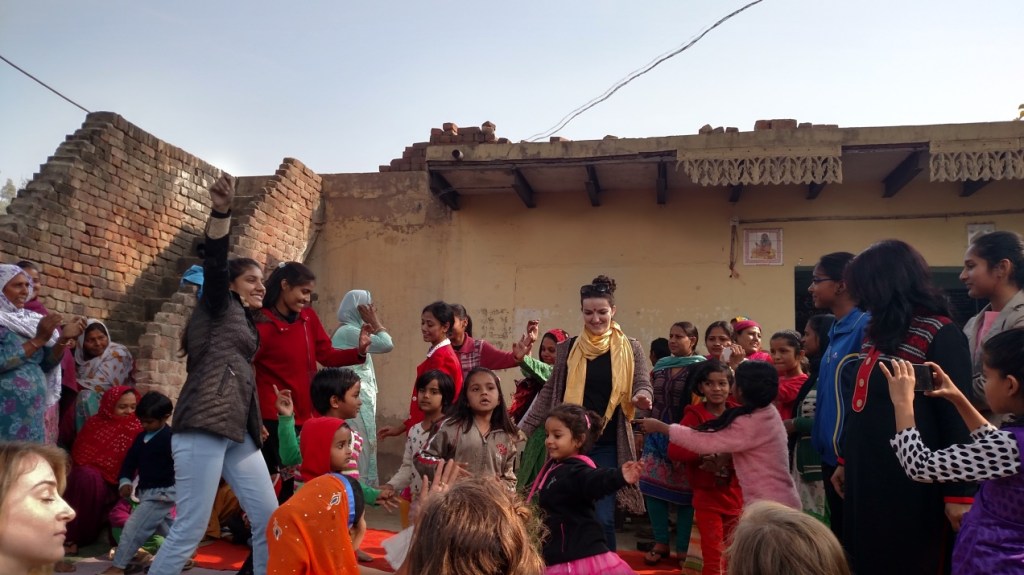
Even in the most patriarchal states of India, like Rajasthan, empowered and elite women have risen and led change from the top down. But change does not have to be only from those of the highest social class. The empowered women in the adopted villages spoke loudly and clearly, communicating their ideas and speaking their minds at meetings. They joked, exchanged experiences with us, and brought us to join them in song and dance in celebration of life. The young women of the Jesus and Mary College of Delhi University, with whom we got to converse, are already breaking barriers for women and spearheading change. As demonstrated throughout this trip by the amazing and powerful women that I met – from the leadership of the Guild for Service, to its female and male staff, to the NGOs, and to my colleagues – change is underway happening marginally but making a difference daily.
 K-squared