Growing up in Albania, school was rigorous and could be brutal. In the 1990s, Albania still used a Soviet-inspired, authoritarian system of education in elementary schools: unquestioning obedience, clear hierarchy between teacher and student, extensive rote memorization, hours of homework daily, public recitations pledging loyalty to the motherland, and the use of corporal punishment. Daily, I watched my classmates get hit as I lowered my head and completed required work to perfection, for fear of being next. The best performing students were praised to the highest; as for the “lower” ranking students, the system gave up on them.
After moving to Canada and the USA, the softness of North American education (some might say Western?) was new to me. In elementary school, my classmates learned in colorful rooms filled with books, toys, posters, and paintings on the wall, making arts and crafts, and playing games. Yet, the hands-on activities in which students worked in groups frightened me; I had been accustomed to sitting, listening and doing as I was told, and could not improvise or interact freely with those around me, least of all because of my broken English in a new country. Furthermore, I failed to see the value of it – if we were not learning facts, then what was the point of playing games?
Life has an interesting way of coming full circle. A decade later, I became a teacher of languages in the US and other countries, using similar pedagogy that I initially questioned upon arriving in Canada. A stark contrast to my own educative upbringing, the Rassias method employs interactive activities and games to teach language. However, the brunt of the method involves intensive exercises and repetitions. This teaching method was ideal I thought; I could combine the best of Western and Albanian education; interactive, fun activities along with a rigor that I had been accustomed to as a young student. On my latest mission, with a team of 16 American teachers from Dartmouth College, I headed to China to teach language skills (particularly speaking) and American culture using the Rassias method.
While they had excellent knowledge of English grammar from 10 years of study, my Chinese high school students struggled to speak in sentences. At first, they shrank at their desks in apprehension of the new, interactive teaching techniques and two-way communication. Since choosing volunteers did not work out, I called on students to do activities on the board, present, and work in pairs. I did not stay in the podium, but stepped down from the stage level of the classroom and moved around, joining my students in dialogue.
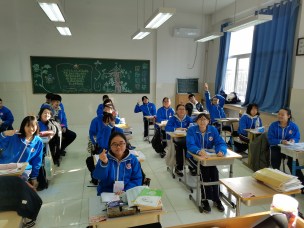
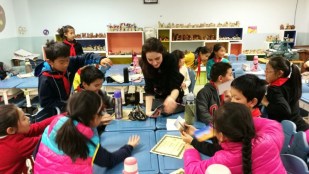
(Photo credit on the left: Lisa)
My elementary level students loved the method, they took to it right away with radiant energy and enthusiasm. Yet, the high school students appeared reluctant. While they could speak well together as a group, when singled out individually, each was very quiet. Generally, American schools praise individuality; Chinese prefer expressing themselves as a group. In the Chinese system, education tends to be “traditional” where students are talked at by teachers, sit in their chairs, read enormously, and occasionally write. Having been in their seats once in a similar pedagogy, I understood their fears, but also the value that our English program provided for them. After encountering a bit of resistance from some of my high school students, I felt obliged to explain openly to them.
“I am not here to teach you reading and writing – you have learned that in your English classes for 10 years now.” I illustrated a graph of their high reading skills on the board and stepped down from the front stage. “This book,” I lifted one of the student’s English book, “will not be with you when you leave the classroom, visit New York, or are in a business meeting with people who speak English.” I asked two students to stand and face their classmates, “You need to know to express your thoughts to your peers (not to the teacher!).” And then I moved to join the rest of their classmates, “These are the people you will work with. And when your peer talks, you listen, and vice versa.” I walked around some more, “Information will not come to you only in the form of a book, but rather, you will encounter e-mails, see a billboard ad, a film, music clips, a lost tourist, a work colleague, etc.”
And there I grasped the greatest value that our English program added to the school. “This class is about communication, learning to stand up and present oneself to the world, learning to listen to others, to solve problems together creatively and using improvisation (when I put you in teams or group work). And these are skills that go beyond this English class – into life and your future work.” A breakthrough was taking place.
In some of the more innovative ideas, I broke the class up into smaller group discussions led by Dartmouth College teachers, had the students build their own stories, asked them to analyze movie and music clips, compete in games on the board, taught them dance lessons in English, and more.


An achievement was bringing into my class some of the least enthusiastic students – my student athletes in the back, who were “too cool” for class and preferred doing Chinese homework during class instead. With the progression of the program, they became enthusiastic, came to speak to me after class, and participated better than ever. This opened my mind more – education is not about making everyone “the best.” The best in anything is, after all, only relative and does not even exist. It is about finding the potential and light within each student, nurturing it, and bringing it out. And everyone has different strengths and weaknesses.
The Soviet-inspired education in Albania during Communism placed the “best students” with the highest grades into petroleum engineering and medical professions. It forced the lowest performing students into the army. The cruelty and degradation of this is clear, but not the topic of my blog at this time.
Even though I was a beneficiary of it, the entire concept of students with the “highest grades,” somehow being “better” is a false social construction. People have so much potential in infinite ways. My students proved that through their diversity of strengths and personalities. I saw how even those who were shy and quiet found their voices. A teacher should not inspire fear, the way mine did in Albania; rather, the positive change that my students experienced defines the essence of what a teacher should facilitate. A teacher should break down barriers that students may have against “authority” positions and within themselves, psychological barriers and inhibitions that prevent students from trying.
By the end of the program, my students, who at first could quietly put together only a few words, were now presenting confidently to the class and speaking in paragraphs all on their own.
Indeed, the best part of my visit to China was my students. I loved getting to connect with them and helping to bring out their potential in English. Watching their development from nervous individuals to confident and accurate speakers was proof of how effective the Rassias method is. Yet, the value that we added goes beyond language skills. I saw students develop greater confidence, creativity, problem solving, and communication skills that will serve them well in life.
The students’ curiosity, enthusiasm, energy, and love is truly humbling, as was the gratitude of the helpful and kind Chinese staff that we worked with. Being able to engage on such a deep level with the people in China was a rare opportunity and privilege.
* * *
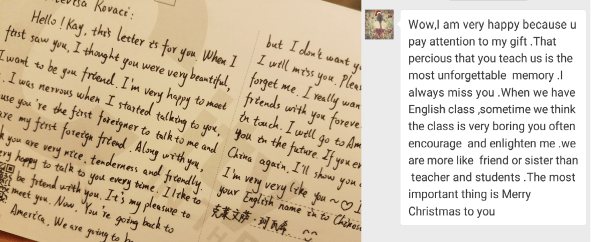
I slowly opened the door and walked through into the dark classroom. Suddenly, the lights came on and in front of a beautifully decorated blackboard, my students shouted, “Surprise!” With no words left and on my final day, my eyes teared as I read across the board messages from my students. “You are the best teacher.” “I love you.” And the most touching, “When I grow up, I will go to see you.”
One of the most fantastic experiences of my life made this among the most rewarding work I have done. I guess the team and I succeeded in transcending barriers and making a difference in our own small way. By the end of this amazing and touching journey, these students, my high schoolers and the children alike (“my angels” as I affectionately called them), moved me – they are in my heart. As I keep in touch with a few, I look forward to one day seeing some of them again.

(Photo credit: Lisa)

 K-squared
Klevisa, you re a gem to this world! The soviet inspired method is still going strong in Russia, sadly..
LikeLiked by 1 person
Thank you, Thanakorn! You are right, the Soviet-modeled pedagogy continues to reign in Eastern Europe, and particularly Russia. Perhaps with the forces of time, increased globalization, and increased cultural exchanges, it may eventually evolve at some point, albeit slowly? I have seen education in Albania and France going though that evolution…
LikeLike
Inspiring article Klevisa…Thanks for touching the lives of these kids…they will forever remember you…!
LikeLiked by 1 person
Thank you Alvin! And likewise, my friend, continue your excellent work in Liberia. You are the shining example of of touching young people’s lives through leadership training.
LikeLike